
Own system / AI agents · 2026
Software factory
An operating system in which AI agents build, review, ship and support 77 software products. An independent agent reviews every automated change before it goes live.
Situation
A portfolio of websites, Mac apps, iPhone apps and audio plug-ins had to grow without a team growing alongside it. Every product needs builds, tests, updates, security checks, releases and support. With a conventional division of labour, one person could not run it.
Approach
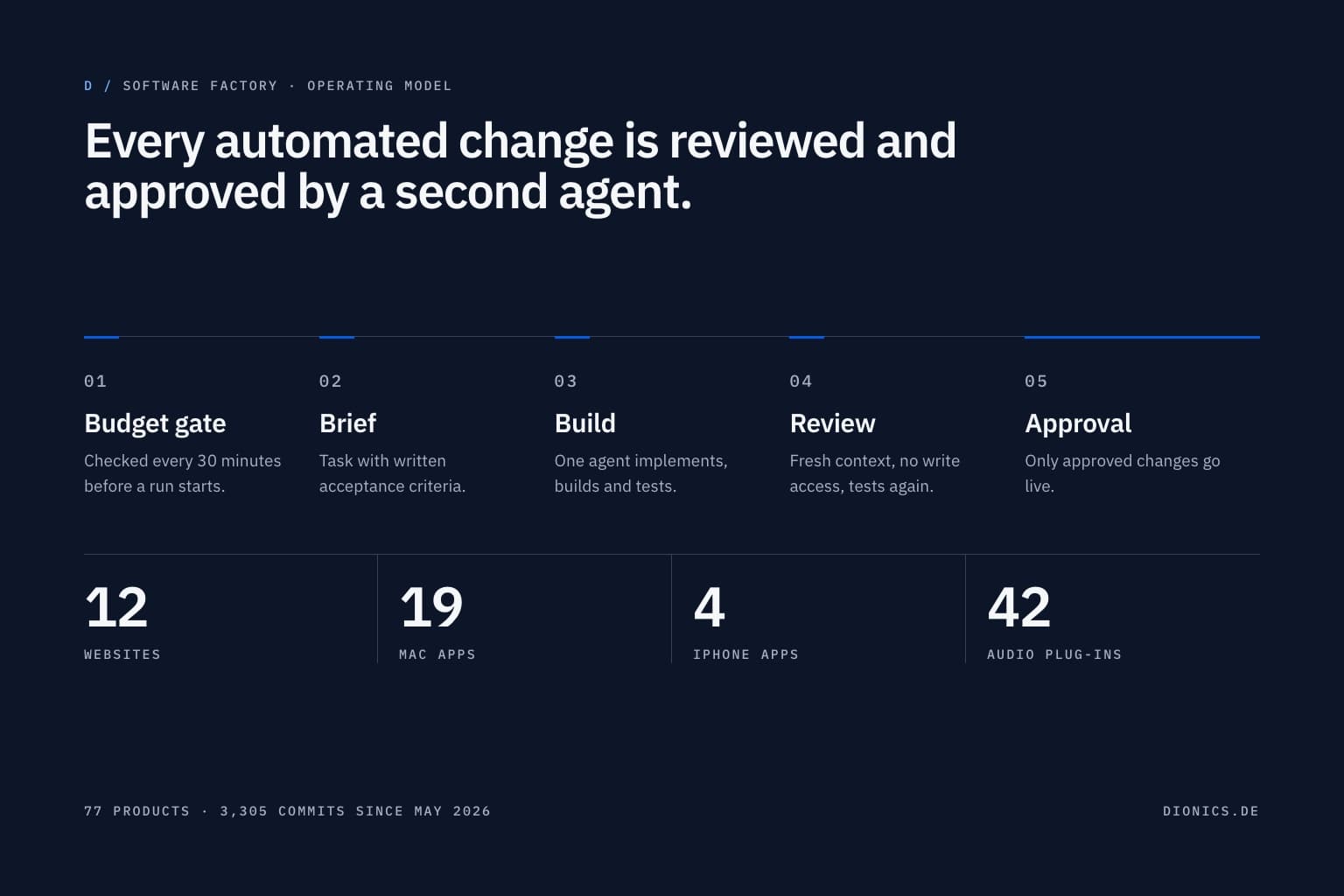
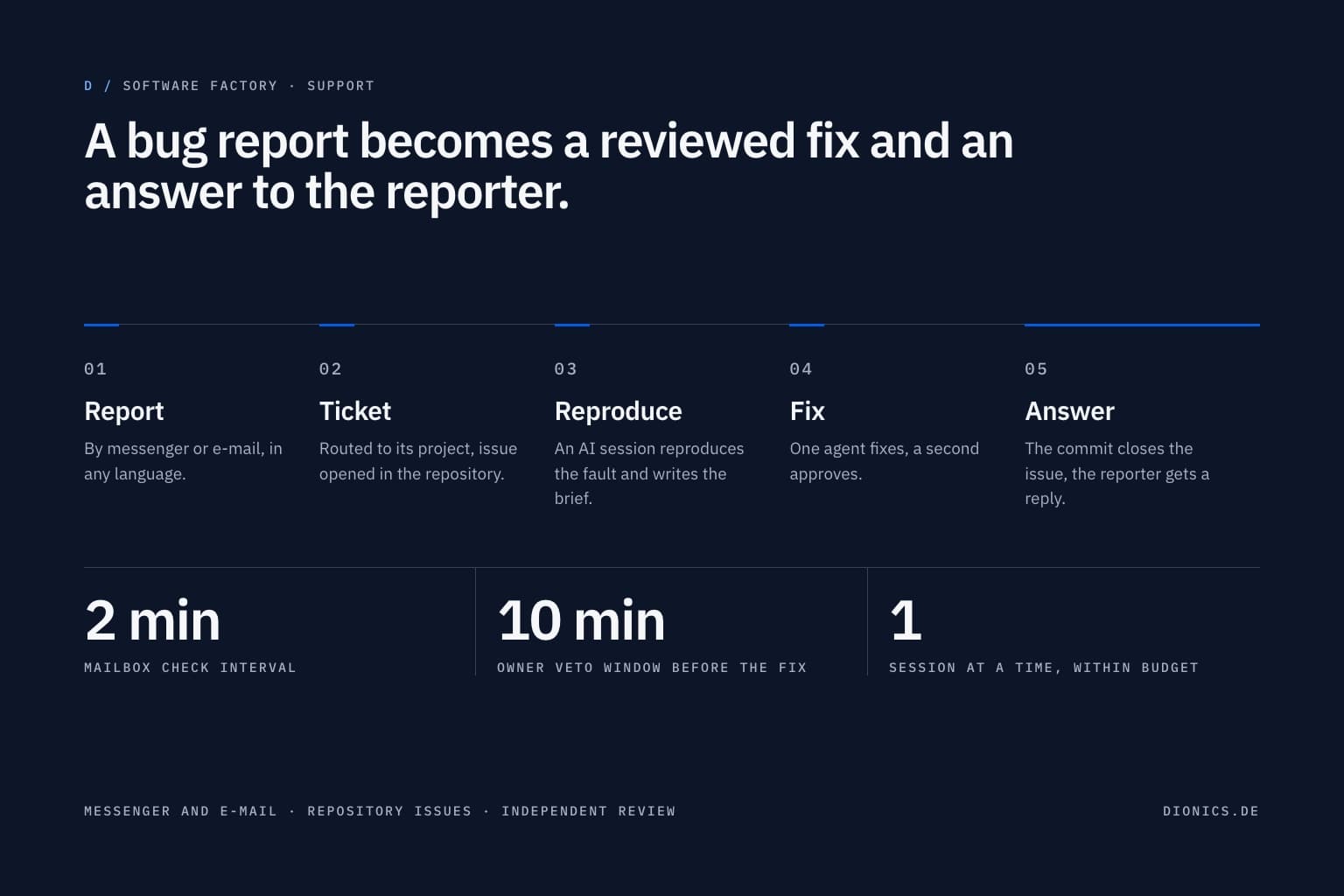
Work runs through a registry and fixed roles. The registry describes every project with its build, tests and status. Every 30 minutes a budget gate decides whether a run may start. An orchestrating agent writes a brief with acceptance criteria, a worker implements it, and a third agent reviews it with fresh context and no write access. Only its approval puts a change live. Bug reports arrive by messenger or e-mail and pass through the same chain as tickets.
Result
77 products in one operation: 12 websites, 19 Mac apps, 4 iPhone apps and 42 audio plug-ins. Since May 2026 their repositories have gained 3,305 commits, and the orchestrating agent has written 204 briefs with acceptance criteria. A daily run checks every dependency for security advisories, signed releases go through their own pipeline, and a shop sells licences for the plug-ins and Mac apps.
- Products in operation
- 77
- Commits since May 2026
- 3,305
- Briefs with acceptance criteria
- 204
- Budget gate interval
- 30 min
What this means for a group
For a group, the factory is a model at small scale. It shows how AI agents take on work for good, who reviews their output, where costs are capped and how leadership can see the current state at any time through a registry.
Year
2026
Role
Concept, architecture, operations
Fields
AI agents, Operating model, Governance
How this system works inside the Dionics AI operation is described under AI in operation. Your own plans are a topic for a confidential first call.