
Software factory
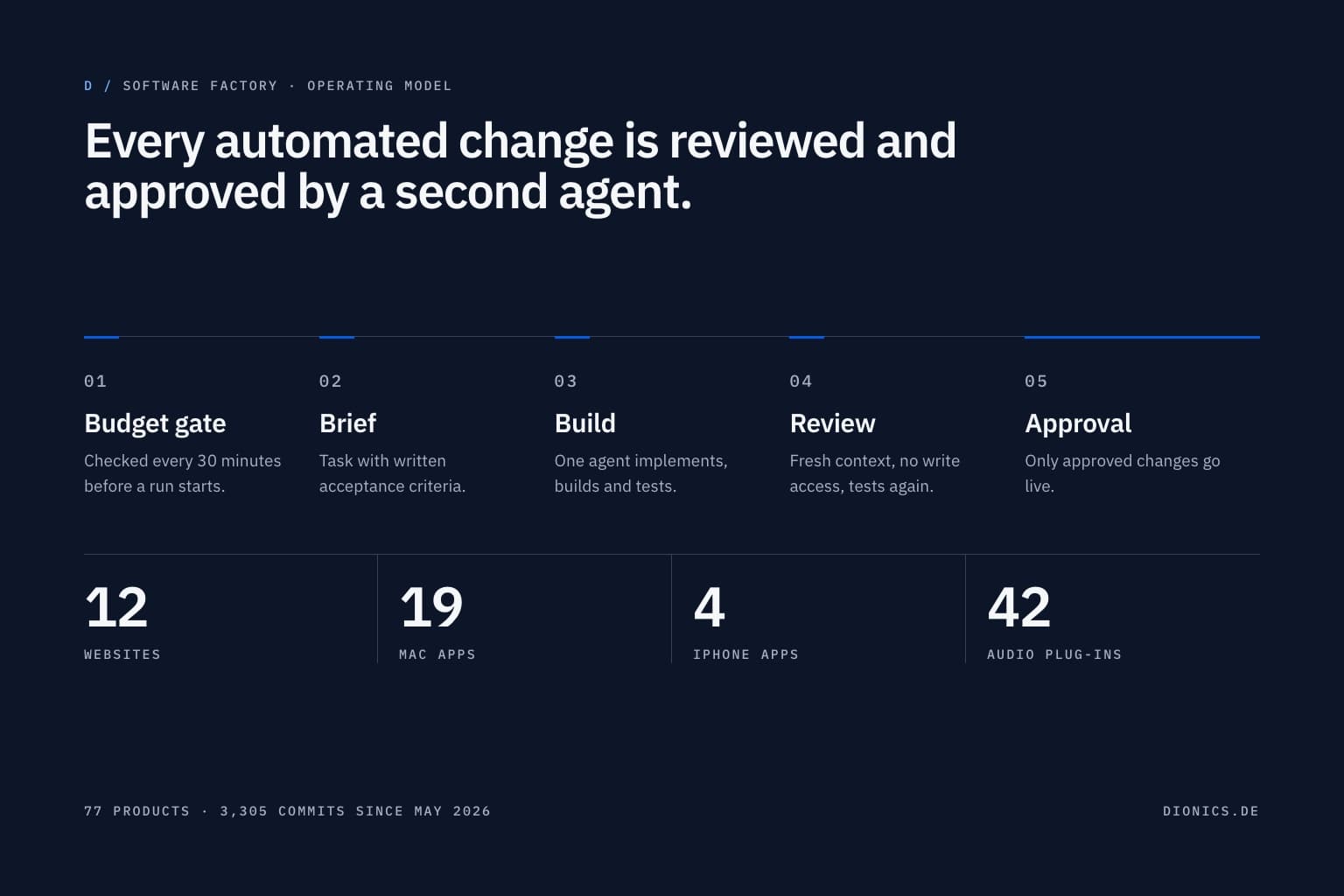
An operating system in which AI agents build, review, ship and support 77 software products. An independent agent reviews every automated change before it goes live.
AI agentsOperating modelGovernance
D / AI in operation
Since May 2026, AI agents have been building, reviewing and maintaining 77 software projects under Dionics. This page describes how the system works and which rules I bring from it into client engagements.

Every product is its own Git repository. A registry records how each one is built and tested and what state it is in.
12
Next.js on Vercel, this site among them. The agents maintain content, search optimisation and dependencies.
19
Native macOS applications in Swift, shipped signed.
4
Expo and SwiftUI, each with its own build and test path.
42
Instruments and effects as AU, VST3 and standalone, built with JUCE and licensed through a shop.
D / Process
The agents run on Claude by Anthropic in Claude Code. Three roles are kept apart: the orchestrating agent writes no code, the worker does not judge its own work, and the reviewer cannot change anything.
01
Every 30 minutes the system checks whether the budget allows a run. When it is used up, nothing starts.
02
An orchestrating agent picks the most important open task and writes a brief with acceptance criteria.
03
A worker agent implements the brief in the project, builds it and runs the tests.
04
A second agent without write access reads the change against the brief and tests again. It never sees the worker's report.
05
Only its approval puts the change live. After two rounds without approval the system discards it.
Each brief carries a review depth by risk: light for text, standard for ordinary code, deep for payments, licences, user data and sign-in. The reviewer has to approve in every case.
If a run leaves changes behind without an approval, the system flags it and the next run starts with that warning.
Reports arrive by messenger or e-mail. Each one becomes a ticket and an issue in the repository of the product concerned.
An AI session reproduces the fault, writes a brief and has it implemented and independently reviewed on the same principle. The commit closes the issue, and the reporter gets an answer on the channel they wrote on.
01
A second agent with fresh context and no write access reviews every automated change. Carried over, this means every AI process has a reviewing party that had no hand in the result.
02
An agent starts only once it is written down how its result will be measured. Without that criterion, the effect of an AI deployment cannot be shown.
03
Before every run the system itself checks whether the budget allows it. In large organisations, too, that limit belongs inside the process itself.
An operating system in which AI agents build, review, ship and support 77 software products. An independent agent reviews every automated change before it goes live.
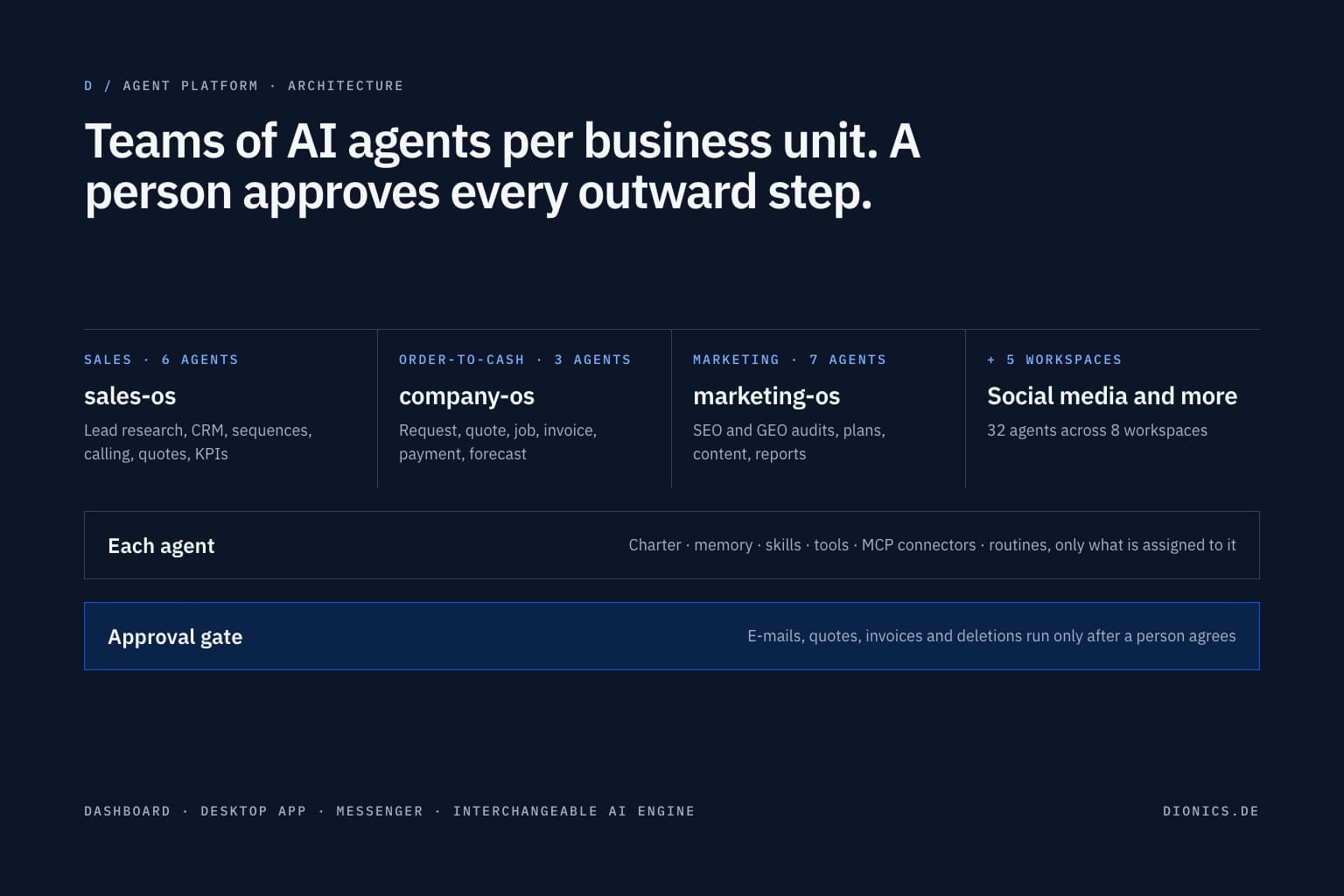
A platform on which teams of AI agents take on tasks in sales, order-to-cash and marketing. Every step that leaves the company waits for a person's approval.
A short message about your topic is enough. I will get back to you personally, usually within one working day.
Request a first callOr write directly: websites@dionics.ai